
Home » Alle berichten » Business » Mastering scrum terminology for clearer communication and stronger agile delivery
Mastering scrum terminology for clearer communication and stronger agile delivery
Scrum terminology often looks simple on the surface, but misunderstandings around these terms are one of the most common reasons agile teams struggle to deliver consistently. When everyone uses the same words but understands them differently, communication breaks down, processes weaken and planning becomes unreliable. This article explores scrum terminology in a deeper and more practical way, helping you apply each concept with clarity so your team can genuinely benefit from agile thinking rather than simply using its vocabulary.
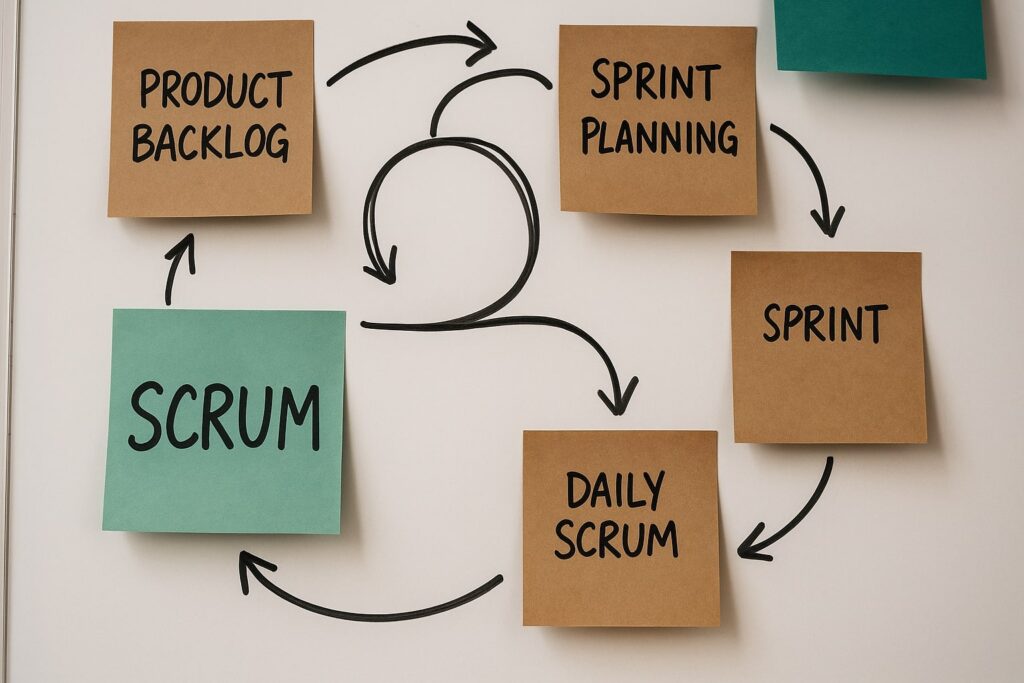
In short:
Scrum terminology strengthens collaboration by giving teams a shared operational language.
Misunderstood terms like “Definition of Done,” “velocity” and “increment” often lead to failed expectations.
Roles exist to balance responsibilities — not hierarchy — and misinterpreting them weakens delivery.
Events provide rhythm and accountability, but only when their purpose is fully understood.
A consistent glossary keeps communication aligned as teams and projects scale.
Why understanding scrum terminology matters
Scrum is built on lightweight structure and disciplined communication. The framework depends on clarity — not complexity — yet mistakes often happen because people assume they already understand the terms. “Sprint,” “backlog,” “increment” and “story point” are used casually, even though each has a specific meaning that directly shapes planning and delivery.
When everyone interprets the terminology differently, the result is inconsistency. Estimates become unreliable, sprint outcomes become unpredictable and misunderstandings start to accumulate. TheGrowthIndex.com frequently highlights that weak communication is one of the biggest causes of delivery delays, which makes mastering scrum terminology a strategic advantage rather than a theoretical exercise.
The core scrum roles and why their terminology matters
Scrum defines three roles — Scrum Master, Product Owner and Development Team (or Developers). These are not job titles or hierarchies; they are accountability structures. Understanding how the terminology behind these roles works helps teams avoid the common trap of “scrum theater,” where roles exist in name but not in practice.
The Scrum Master is responsible for enabling the scrum process. The term is often misunderstood as a project manager, but the real focus is facilitation, coaching and removing obstacles. The terminology emphasizes service, not authority.
The Product Owner owns the value. “Owner” is critical — not manager, not analyst. They decide priorities and maximize impact. Misinterpreting this role often leads to scattered focus or scope creep.
The Developers include everyone building the product increment. Designers, writers, engineers and analysts all fall under this term. Using “developer” loosely helps reduce departmental silos and aligns everyone under shared responsibility.
Also interesting



Scrum terminology for artifacts: where teams often misunderstand
Scrum artifacts exist to provide transparency. Without understanding the terminology around them, transparency breaks down.
The product backlog
The product backlog is a dynamic list of everything that may be needed. The important terminology often ignored is that it is “ordered,” not “prioritized,” which allows multiple criteria (value, risk, dependencies) to shape the sequence.
The sprint backlog
The sprint backlog includes the selected product backlog items and the plan for delivering them. Many teams misunderstand this, thinking it only includes user stories. The terminology clarifies that the sprint backlog also covers the work required to meet the Sprint Goal.
The increment
The increment must be usable. This is where terminology matters most. An increment is not “progress,” “work in progress” or “almost done tasks.” It is a potentially shippable, tested, integrated output. This distinction ensures teams avoid accumulating invisible technical debt.
Scrum terminology within sprint events
Scrum events give rhythm to work. Misunderstanding their terms undermines that rhythm.
Sprint
A sprint is a fixed-length period, usually one to four weeks. The important terminology is “fixed,” meaning the duration does not change based on workload. Changing sprint lengths weakens predictability.
Sprint Planning
The terminology here focuses on two questions:
What can we deliver?
How will we deliver it?
Many teams only address the first question, which leads to unclear plans and unpredictable execution.
Daily Scrum
Also known colloquially as the “stand-up,” the official term is Daily Scrum for a reason. It is not a status meeting but an inspection-and-adaptation event for the Developers. Using the wrong term shifts the purpose and makes the meeting report-heavy rather than outcome-driven.
Sprint Review
This event is about inspection and collaboration, not demonstration. “Review” is broader than “demo,” encouraging teams to gather feedback, analyze results and refine future work.
Sprint Retrospective
The terminology emphasizes “process improvement,” not blame. A retrospective analyzes how the team can improve collaboration, tools and processes. The focus is on system refinement, not performance evaluation.
The most misunderstood scrum terminology
Some scrum terminology causes chronic confusion. Clarifying these terms immediately improves team performance.
Definition of Done (DoD)
This is a shared agreement on quality. It is not a checklist for a single story; it applies to all backlog items. Teams often confuse DoD with “Acceptance Criteria,” which are specific to each item. Treating them as the same leads to inconsistent output.
Story points
Story points represent effort, complexity and risk — not hours. When teams equate points to time, estimation collapses. The terminology shifts the focus away from deadlines and toward relative effort, improving predictability.
Velocity
Velocity measures the number of story points completed per sprint. It is not a performance metric and should never be used to compare teams. The terminology highlights “completed,” meaning only done work counts — not partially finished items.
Sprint Goal
A Sprint Goal describes the purpose of the sprint, not the list of items. When the terminology is misunderstood, teams chase tasks without alignment. A clear goal makes decisions sharper during the sprint.
Step-by-step: how to use scrum terminology to strengthen collaboration
Using the correct terminology is more than being technically accurate. It shapes how teams think and work.
Create a shared glossary. Align the team on terminology definitions.
Use terms consistently in all meetings. This builds habits and reduces misunderstandings.
Clarify terminology with new team members. Onboarding is smoother when the vocabulary is standardized.
Stop using vague or misleading synonyms. Terms like “demo,” “task list,” or “status meeting” dilute purpose.
Reinforce terminology through templates. Backlog templates, sprint planning guides and DoD checklists help teams embed consistent language.
This small investment improves communication speed and accuracy, especially in distributed teams.
"Clarity in scrum terminology is not about speaking the language — it is about building a shared understanding that strengthens every decision the team makes."
The most misunderstood scrum terminology
Some scrum terminology causes chronic confusion. Clarifying these terms immediately improves team performance.
Definition of Done (DoD)
This is a shared agreement on quality. It is not a checklist for a single story; it applies to all backlog items. Teams often confuse DoD with “Acceptance Criteria,” which are specific to each item. Treating them as the same leads to inconsistent output.
Story points
Story points represent effort, complexity and risk — not hours. When teams equate points to time, estimation collapses. The terminology shifts the focus away from deadlines and toward relative effort, improving predictability.
Velocity
Velocity measures the number of story points completed per sprint. It is not a performance metric and should never be used to compare teams. The terminology highlights “completed,” meaning only done work counts — not partially finished items.
Sprint Goal
A Sprint Goal describes the purpose of the sprint, not the list of items. When the terminology is misunderstood, teams chase tasks without alignment. A clear goal makes decisions sharper during the sprint.
Step-by-step: how to use scrum terminology to strengthen collaboration
Using the correct terminology is more than being technically accurate. It shapes how teams think and work.
Create a shared glossary. Align the team on terminology definitions.
Use terms consistently in all meetings. This builds habits and reduces misunderstandings.
Clarify terminology with new team members. Onboarding is smoother when the vocabulary is standardized.
Stop using vague or misleading synonyms. Terms like “demo,” “task list,” or “status meeting” dilute purpose.
Reinforce terminology through templates. Backlog templates, sprint planning guides and DoD checklists help teams embed consistent language.
This small investment improves communication speed and accuracy, especially in distributed teams.
How scrum terminology enhances predictability
Predictability is not about working faster — it is about making reliable commitments. When teams understand terminology clearly, they estimate better, plan better and adapt better.
For example:
Clear DoD reduces rework.
Proper understanding of velocity improves forecasting.
A precise Sprint Goal creates alignment.
Predictability leads to more confident decision-making, something TheGrowthIndex.com highlights as essential for scaling teams sustainably.
Avoiding misuse of scrum terminology in hybrid environments
Many organizations practice a hybrid of agile and traditional methods. This can create terminology conflicts. For example, mixing “milestones” with “increments” or “resource allocation” with “self-management” undermines scrum principles.
To prevent this:
Define boundaries: when to use scrum terms and when not to.
Avoid borrowing terms from waterfall methodologies.
Educate leadership on the meaning of scrum terminology to reduce misinterpretation.
Hybrid environments can succeed, but only when terminology remains consistent.
Also interesting



Teaching scrum terminology through practice rather than theory
Scrum terminology becomes meaningful only when tied to real behavior. Instead of memorizing definitions, teams should experience the terms in action. This develops intuition and shared understanding.
Methods include:
Running mock sprints
Practicing backlog refinement sessions
Reviewing real increments to align on DoD
Observing how Sprint Goals influence decisions
Teaching terminology through practical application strengthens adoption far more effectively than formal presentations.
Using scrum terminology to elevate strategic thinking
Scrum terminology is not just operational; it influences higher-level strategy. Understanding terms like velocity, increments and sprint goals helps teams make better roadmap decisions. For example, velocity patterns inform capacity planning, while retrospectives reveal systemic inefficiencies.
When teams master terminology, they move beyond executing tasks and begin shaping strategy with insight and confidence.
How scrum terminology supports scaling frameworks
Frameworks like SAFe, LeSS or Scrum@Scale all rely on the same foundational terminology. Without alignment on core scrum terms, scaling becomes chaotic. For example, inconsistencies in DoD across teams lead to integration issues, while unclear terminology for backlog items weakens cross-team planning.
To support scaling:
Standardize terminology across teams.
Align DoD definitions before scaling begins.
Ensure Product Owners and Scrum Masters share common vocabulary.
Consistency across teams accelerates coordination and reduces friction.
Building a long-term glossary for evolving scrum terminology
Scrum terminology evolves as tools, practices and industries shift. Creating a living glossary ensures the entire organization evolves together. This glossary can include references to internal processes, templates and examples that clarify how terms are used in context.
Maintaining this glossary helps new employees onboard faster, keeps communication crisp and supports predictable delivery cycles.

Lina Mercer
Lina Mercer is a technology writer and strategic advisor with a passion for helping founders and professionals understand the forces shaping modern growth. She blends experience from the SaaS industry with a strong editorial background, making complex innovations accessible without losing depth. On TheGrowthIndex.com, Lina covers topics such as business intelligence, AI adoption, digital transformation, and the habits that enable sustainable long-term growth.