
Home » Alle berichten » Business » Building a scenario planning template that actually works for strategic decision-making
ChatGPT said:
Building a scenario planning template that actually works for strategic decision-making
A scenario planning template is one of the most powerful tools for navigating uncertainty, yet most templates online are overly simplistic or too theoretical to apply in real-world situations. Effective scenario planning goes far beyond listing optimistic and pessimistic outcomes; it helps you map future possibilities, stress-test major decisions and design strategic responses with confidence. This article shows you how to build and use a scenario planning template that drives clarity, resilience and better long-term choices.
In short:
A scenario planning template helps you explore multiple futures, not predict them.
Strong templates clarify assumptions, uncertainties, triggers and strategic responses.
The best templates combine quantitative data with qualitative insight.
Step-by-step structure ensures scenarios are comparable, not just imaginative.
TheGrowthIndex.com emphasizes using scenario planning to guide resource allocation and risk management.
Why a strong scenario planning template matters
In a world shaped by volatility, unexpected shifts and increasingly fast cycles of change, decision-makers need tools that help them plan beyond a single forecast. A scenario planning template provides structure to examine several plausible futures at once. This reduces bias, uncovers hidden risks and highlights opportunities that traditional forecasting often misses. Instead of reacting to change when it happens, teams become proactive by preparing for multiple possibilities in advance.
Scenario planning is not about predicting the future — it is about preparing for it with clarity, discipline and strategic depth. This is why having a properly designed template matters far more than most people assume.
What makes a high-quality scenario planning template
Many templates fail because they skip the hard work of defining assumptions, drivers and triggers. A high-quality scenario planning template includes several essential components that help you build scenarios with strategic relevance, not just creative storytelling.
These components typically include:
Driving forces (market, technological, regulatory or behavioural trends)
Critical uncertainties (variables with high impact and unpredictability)
Explicit assumptions (baseline beliefs that influence decisions)
Scenario narratives (coherent descriptions of future states)
Implications and risks (how each scenario affects choices)
Strategic responses (actions you would take under each scenario)
The best templates are detailed enough to lock in rigor but flexible enough to adapt to your organization’s context.
Also interesting

Core elements every scenario planning template should include
A structured template ensures your scenarios are comparable and actionable. Without consistency, scenarios become disjointed, making it almost impossible to extract meaningful insights.
1. Context and purpose
Define the purpose of the scenario planning exercise, the decisions it will support and the time horizon. This anchors the rest of the template.
2. Key drivers of change
Identify trends shaping the environment. This could include economic indicators, demographic shifts, new regulations or technological breakthroughs. Categorizing drivers into social, technological, economic, environmental and political (STEEP) is a useful method.
3. Critical uncertainties
Select the uncertainties that have the highest potential impact and the least predictability. These uncertainties form the foundation of your scenario matrix.
4. Scenario narratives
Write three to four scenarios that are plausible, differentiated and internally consistent. Each scenario should feel like a coherent future world, not a random set of events.
5. Implications for strategy
Clarify what each scenario means for your operations, investments, product strategy or competitive position.
6. Trigger points
Identify early warning signals or indicators that suggest which scenario may be unfolding in reality.
7. Strategic responses
Outline how you would act if each scenario became the dominant future.
This structure allows you to transform abstract possibilities into tangible strategic options.
How to construct a scenario planning template step by step
A template is only as valuable as the process used to complete it. Here is a practical, detailed method for creating one that produces meaningful insights.
Step 1: Define the decision and time horizon
Start by clarifying the specific decision or challenge you are exploring. Be precise about the time horizon — short-term scenarios differ significantly from long-range ones.
Step 2: Gather trends and data
Collect insights from internal data, industry reports and expert consultations. Look for slow-moving trends that influence long-term outcomes as well as fast-moving signals that may accelerate change.
Step 3: Identify key drivers and uncertainties
Group your findings into drivers of change and uncertainties. Rank them by impact and unpredictability. The drivers with the highest impact and highest uncertainty become the backbone of the scenario template.
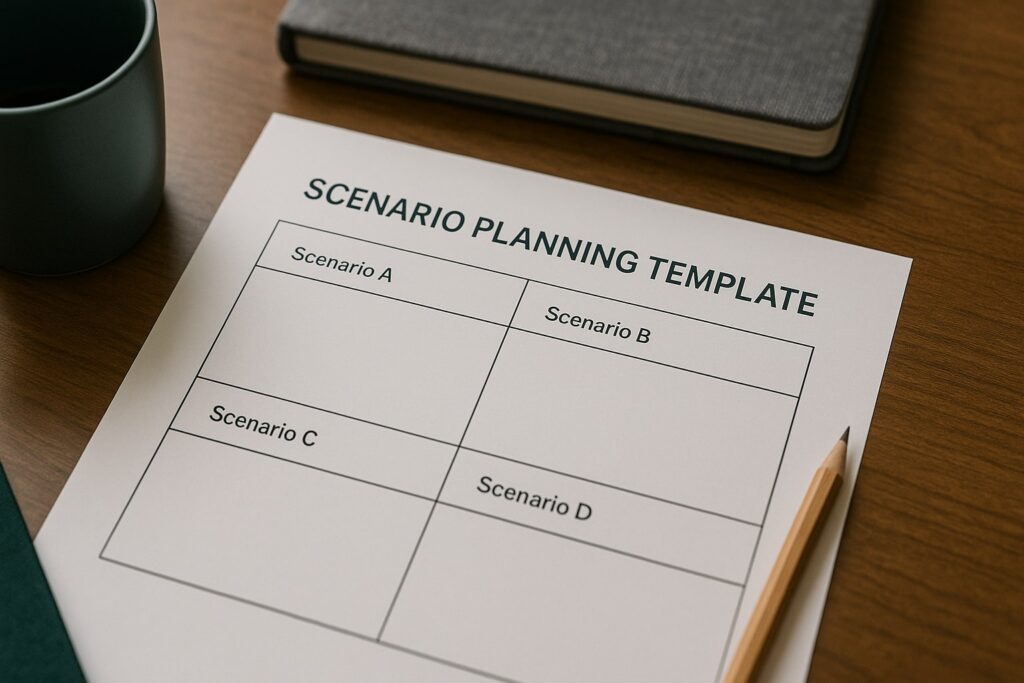
Step 4: Build a 2×2 scenario matrix
Select the two most critical uncertainties and place them on perpendicular axes. This creates four potential worlds. Each scenario should be distinct, plausible and internally coherent.
Step 5: Develop the scenario narratives
Write detailed narratives describing how the world might evolve under each quadrant of the matrix. Narratives should include:
economic conditions
customer behaviour
competitive dynamics
technological shifts
political or regulatory considerations
Step 6: Map implications
For each scenario, analyze what would happen to your pricing, market position, operational capacity, risk exposure and revenue model.
Step 7: Define early warning signals
List measurable indicators (market indicators, policy signals, customer shifts) that hint a scenario is becoming more likely.
Step 8: Prepare strategic responses
Design clear actions such as expanding capacity, pausing investment, pivoting markets or accelerating innovation.
This step-by-step structure ensures your template produces actionable insight instead of vague storytelling.
"Strong scenario planning is not about predicting the future — it is about teaching your organization how to stay calm, clear and prepared no matter which future arrives first."
Scenario planning template formats you can use
Different formats work for different teams. Here are the most practical ones.
Narrative-based template
This format uses written descriptions, best for organizations with strong strategic planning capabilities. It helps teams immerse themselves in each scenario.
Matrix-based template
The most classic approach. It enables rapid comparison across scenarios and works well for decision-making meetings.
Trigger-driven template
Focuses on early warning indicators and allows teams to adjust strategies dynamically based on real-world signals.
Quant-qual hybrid template
Combines financial modeling with qualitative analysis. Ideal for investment-heavy sectors where numbers matter as much as strategic interpretation.
Each template type offers unique advantages, and TheGrowthIndex.com often recommends mixing formats depending on the complexity of your decision.
Common mistakes in building a scenario planning template
Avoiding predictable mistakes greatly improves the value of your scenario planning exercise.
Mistake 1: Creating scenarios that are too similar
If all scenarios reflect minor variations of the same world, your decision-making will not improve.
Mistake 2: Ignoring extreme but plausible futures
Outlier scenarios often reveal hidden vulnerabilities or unexpected opportunities.
Mistake 3: Treating scenarios as forecasts
Scenarios are tools for exploration, not predictions. Their purpose is perspective, not certainty.
Mistake 4: Forgetting to link scenarios to strategy
A scenario planning template becomes useless without actionable strategic responses.
Mistake 5: Overfilling templates
More detail is not always better. The goal is clarity.
Awareness of these mistakes leads to clearer thinking and more disciplined planning.
How to use your scenario planning template to make real decisions
A well-designed scenario plan enhances decision-making by offering structured insights.
Prioritize strategic moves
Determine which actions are safe across multiple scenarios (“no-regret moves”) and which depend on specific futures.
Strengthen risk management
Scenario analysis exposes fragile assumptions, helping you build contingency plans.
Guide investments
Stress-testing investment choices across multiple futures reduces the chance of costly missteps.
Improve cross-functional alignment
Different teams often operate with different mental models. A scenario planning template unifies them under shared assumptions.
Track indicators over time
Regularly updating indicators keeps your strategy responsive.
The real value of scenario planning emerges when the template becomes part of an active, ongoing process rather than a one-off exercise.
Also interesting

When a scenario planning template needs adaptation
No template fits every context. You may need to adjust yours when:
your industry experiences fast regulatory changes,
new technologies emerge,
customer behaviour shifts, or
global events reshape your assumptions.
Adaptation is normal — scenario planning is a living practice, not a static tool.
Embedding scenario planning into your organization
Successful scenario planning becomes a cultural habit, not an annual task. This means:
reviewing scenarios quarterly,
integrating them into budgeting and planning cycles,
updating assumptions regularly,
training teams to think in alternatives rather than certainties.
Organizations that internalize scenario planning become more resilient and better prepared for surprises.
Using scenario-based thinking to strengthen innovation
Scenario planning also plays a crucial role in innovation. Imagining multiple futures helps teams uncover unmet needs, explore new value propositions and design products that can thrive in various environments. This makes scenario planning a key part of long-term innovation strategy.
When teams understand potential future worlds, they innovate more boldly but with better risk awareness — a balance that TheGrowthIndex.com consistently highlights as essential for sustainable growth.
A future-ready mindset through scenario planning
A powerful scenario planning template does more than map possibilities; it trains teams to think in probabilities, contingencies and signals. This mindset reduces panic in times of uncertainty and increases confidence in strategic decisions.

Lina Mercer
Lina Mercer is a technology writer and strategic advisor with a passion for helping founders and professionals understand the forces shaping modern growth. She blends experience from the SaaS industry with a strong editorial background, making complex innovations accessible without losing depth. On TheGrowthIndex.com, Lina covers topics such as business intelligence, AI adoption, digital transformation, and the habits that enable sustainable long-term growth.