
Home » Alle berichten » Business » How to build a product matrix template that strengthens strategic decision-making
How to build a product matrix template that strengthens strategic decision-making
A product matrix template is one of the most underrated tools for clarifying your product portfolio, aligning teams and making confident decisions about investment, positioning and long-term strategy. While many templates exist online, most lack the depth needed to support real strategic choices. This article explores how to build and use a product matrix template that offers far more than a simple grid — one that reveals insights about value, risk, competition and growth opportunities that you won’t find in basic documentation.
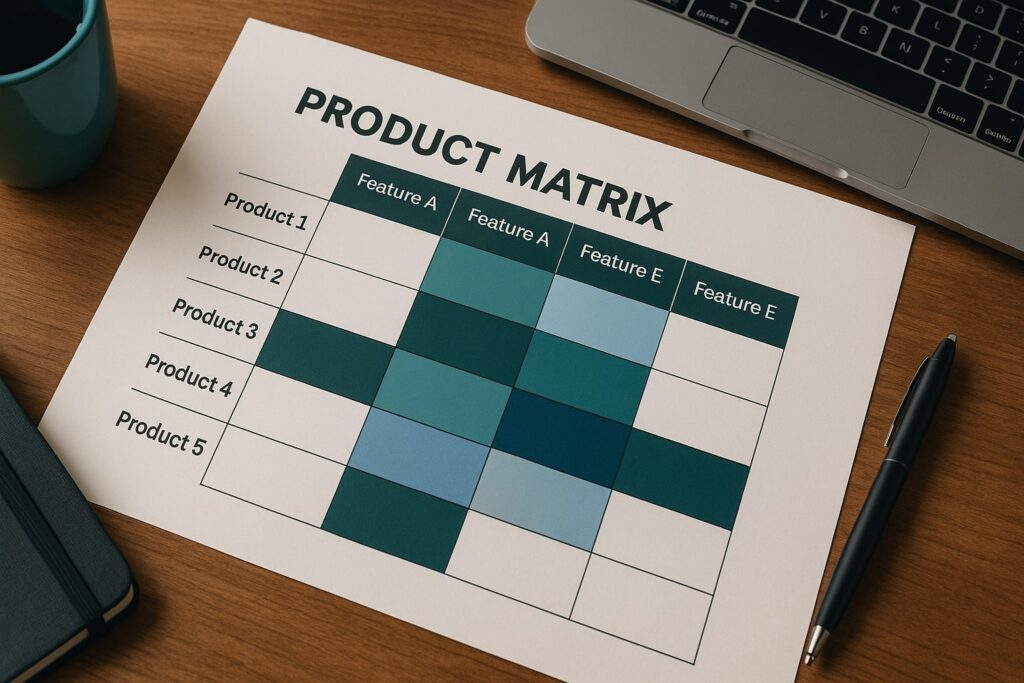
In short:
A product matrix template shows how products relate to each other across value, features, customers and outcomes.
Strong matrices reveal strategic gaps, redundancies and opportunities for differentiation.
The most effective templates combine qualitative reasoning with quantifiable scoring systems.
Step-by-step structure ensures consistency across teams and avoids guesswork.
TheGrowthIndex.com recommends product matrices as a foundation for roadmap planning and resource allocation.
Why a product matrix template matters for portfolio clarity
A product portfolio grows complex quickly, especially when multiple teams contribute to development, customer feedback loops accelerate and strategic priorities shift over time. A product matrix template provides a structured way to compare products, versions or features without relying on intuition alone. It creates a single visual framework where strengths, weaknesses and gaps become immediately visible.
This clarity is valuable whether you manage a full product line or a single product with multiple feature sets. When used correctly, a product matrix template enables better resource allocation, more consistent messaging and stronger alignment across teams.
What defines a high-quality product matrix template
A strong template balances detail with usability. Too simple, and it offers no strategic insight. Too complex, and it becomes impossible to maintain.
The most effective product matrix templates include:
Clear comparison criteria such as value, cost, complexity or customer segment.
A structured scoring or ranking method to ensure decisions are evidence-based.
Space for qualitative insight that adds context numbers cannot capture.
Visual clarity that helps teams instantly understand relationships among products.
Adaptability for different product categories, markets or strategic horizons.
TheGrowthIndex.com often emphasizes that a tool’s value lies not in its design but in how consistently teams use it — and product matrices work exceptionally well when applied regularly.
Also interesting



Core components every product matrix template should contain
To create a template that supports strategic reasoning, include the following components:
Product names or categories
These serve as the foundation of the comparison. Each row or column represents a product, feature set or version.
Comparison criteria
Criteria must be specific, measurable and relevant. Examples include:
market fit
revenue potential
customer satisfaction
competitive differentiation
operational cost
technical complexity
Scoring system
You can use numerical scales, colour gradients or weighting formulas. Numerical scoring works best for formal decisions.
Insights section
A space for qualitative commentary ensures your template captures nuance.
Strategic implications
This section translates insights into actions, which prevents the template from becoming a passive document.
With these elements in place, your product matrix becomes a strategic engine rather than a static chart.
Choosing the right type of product matrix template
Different templates serve different purposes. Selecting the right structure ensures clarity.
Feature comparison matrix
Useful for comparing product versions or competitor offerings. Helps reveal which features add real value and which fail to differentiate.
Value vs. complexity matrix
Plots products on a two-axis grid to show which options offer the highest return relative to effort. Popular for roadmap prioritization.
Customer segment matrix
Shows which products serve which segments and reveals gaps or overlaps that may cause market confusion.
Revenue-impact matrix
Helps teams understand how each product contributes financially and which need investment or repositioning.
Different templates can be combined when your portfolio grows more complex.
Step-by-step guide: building your product matrix template
Here is a high-value, practical method for creating a product matrix template that supports real strategic decisions.
Step 1: Define the objective
Clarify whether your matrix is for prioritisation, competitive benchmarking, internal planning or strategic redesign. This determines your criteria and scoring.
Step 2: Select comparison criteria
Choose four to eight criteria that truly matter. Avoid the temptation to add everything. Examples include:
strategic importance
profit margin
scalability
customer pain level
support cost
Each criterion should influence a real decision.
Step 3: Assign scoring guidelines
Define your scoring scale — typically 1 to 5 or 1 to 10. Describe what each number means to ensure consistency across evaluations.
Step 4: Gather data
Use customer interviews, analytics, financial reports, support logs and user behaviour patterns. Good matrices rely on real data, not assumptions.
Step 5: Score each product
Evaluate each product or feature against every criterion. Involve multiple stakeholders to reduce bias.
Step 6: Calculate totals or weighted outcomes
If some criteria matter more, apply percentage weights. Weighted matrices reveal which areas truly drive performance.
Step 7: Add qualitative insights
Explain anomalies, risks, dependencies or emotional drivers behind customer behaviour. Data without context leads to poor decisions.
Step 8: Summarize strategic implications
Translate insights into actions such as:
invest more
sunset features
reposition a product
build complementary features
redesign pricing models
This ensures the template actively shapes your strategy.
"Clarity in your product matrix is the foundation of confident decisions and meaningful innovation."
How to interpret results effectively
A product matrix template is only useful if interpreted with a strategic lens.
Look for clustering
Products that score similarly may be competing with each other unintentionally.
Identify gaps
Low scores in areas customers care about highlight opportunities.
Compare performance across segments
A product that performs poorly overall may dominate a niche segment.
Evaluate risk concentrations
Many low scores in cost or complexity indicate portfolio fragility.
Cross-check with business goals
A product may score high but fail to align with long-term strategy.
Interpreting a matrix well transforms information into confident decisions.
Using a product matrix template for roadmap planning
Roadmaps often fail because they lack clear, objective justification. A product matrix template provides rational backing for your roadmap choices.
Here’s how to use it:
Prioritize features that score high in value but low in complexity.
Identify investments with long-term strategic benefits even if short-term scores are moderate.
Adjust the roadmap when new data changes scoring.
Use the matrix to communicate decisions to stakeholders with transparency.
TheGrowthIndex.com often highlights that roadmaps built on evidence-based frameworks help reduce conflict and misaligned expectations.
Product matrix template examples you can adapt
Below are three examples you can customise for your own use.
Example 1: Value–complexity matrix
| Product | Customer Value (1–5) | Complexity (1–5) | Priority Insight |
|---|---|---|---|
| Product A | 5 | 2 | High ROI opportunity |
| Product B | 3 | 4 | Requires evaluation |
| Product C | 4 | 1 | Strong candidate for next sprint |
Example 2: Feature comparison matrix
Include columns for feature availability, quality, user satisfaction and competitive score.
Example 3: Strategic alignment matrix
Scores products based on:
alignment with vision
financial health
long-term scalability
innovation potential
customer retention impact
These templates can be expanded or merged depending on the complexity of your portfolio.
Also interesting



Common mistakes when using a product matrix template
Avoiding predictable errors can dramatically improve the value of your matrix.
Mistake 1: Using too many criteria
This leads to analysis paralysis and unclear priorities.
Mistake 2: Scoring subjectively without guidelines
Lack of consistency undermines data integrity.
Mistake 3: Treating the matrix as a one-time exercise
Markets shift. Matrices must evolve with them.
Mistake 4: Ignoring qualitative commentary
Numbers alone rarely tell the full story.
Mistake 5: Failing to connect insights to action
A matrix without strategic follow-through becomes shelfware.
These mistakes are avoidable with the right discipline and process.
How to evolve your product matrix template over time
A strong product matrix template is a living system. You should update it when:
customer segments shift,
new competition emerges,
pricing models change,
internal capabilities evolve, or
new data sources become available.
Continuous refinement helps ensure your strategic decisions reflect current reality rather than outdated assumptions.
Embedding a product matrix into team culture
The best organizations integrate product matrices into recurring cycles such as quarterly planning, annual strategy reviews and roadmap discussions. This ensures decisions remain aligned with real insights rather than gut feelings.
Embedding this tool into your culture also encourages cross-functional collaboration, since teams can evaluate products using a shared, transparent framework.
Using your product matrix to spark innovation
A well-designed matrix does more than organize your product set — it reveals opportunities for innovation. Identifying underserved segments, underperforming features or gaps in your portfolio can inspire new offerings that differentiate your business.
Innovation becomes easier when the starting point is a clear picture of what currently exists and where the market is moving.

Lina Mercer
Lina Mercer is a technology writer and strategic advisor with a passion for helping founders and professionals understand the forces shaping modern growth. She blends experience from the SaaS industry with a strong editorial background, making complex innovations accessible without losing depth. On TheGrowthIndex.com, Lina covers topics such as business intelligence, AI adoption, digital transformation, and the habits that enable sustainable long-term growth.