
Home » Alle berichten » Software » How risk analysis software strengthens decision-making and organizational resilience
How risk analysis software strengthens decision-making and organizational resilience
Risk analysis software has become a critical component of modern governance and operational strategy. As organizations face increasing regulatory pressure, cybersecurity threats, supply chain volatility, and financial uncertainty, informal risk registers are no longer sufficient. Structured digital tools enable systematic identification, assessment, prioritization, and monitoring of risk exposures. When implemented effectively, risk analysis software transforms fragmented oversight into integrated risk intelligence, improving both strategic confidence and operational resilience.
In short:
Risk analysis software centralizes and structures risk identification and monitoring.
Effective implementation requires governance, not just technical deployment.
Integration with operational and financial data enhances accuracy.
Scenario modeling strengthens preparedness for uncertainty.
Continuous review ensures risk visibility remains relevant and actionable.
Why risk analysis software is strategically important
In complex environments, risk is multidimensional. Operational disruptions, financial volatility, compliance breaches, and reputational threats often intersect. Managing these exposures manually increases the likelihood of blind spots.
Risk analysis software consolidates risk data across departments, providing a unified overview. Instead of isolated spreadsheets maintained by separate teams, organizations gain consolidated dashboards and structured reporting.
This centralized visibility enables leadership to identify systemic vulnerabilities. More importantly, it supports proactive decision-making rather than reactive crisis management.
Core capabilities of effective risk analysis software
Effective risk analysis software typically includes risk identification tools, probability and impact scoring, mitigation tracking, and reporting dashboards. Advanced platforms also incorporate scenario modeling and predictive analytics.
Customizable taxonomies allow organizations to categorize risks according to industry-specific requirements. Automated alerts notify stakeholders when risk thresholds are exceeded.
However, technical features alone do not guarantee value. The platform must align with governance processes and decision-making rhythms to produce actionable insights.
Also interesting


Integrating risk analysis software with governance frameworks
Software implementation without governance integration often leads to underutilization. Risk ownership must be clearly defined at executive and operational levels.
Establishing risk committees or review boards ensures structured oversight. These groups should meet regularly to review dashboards, reassess mitigation plans, and update risk priorities.
On TheGrowthIndex.com, governance discipline is frequently emphasized as essential for sustainable growth. Risk analysis software supports governance only when embedded within formal review structures.
Data quality and consistency in risk assessment
Accurate risk evaluation depends on consistent data entry. Inconsistent scoring criteria or vague descriptions undermine comparability and prioritization.
Standardized risk definitions and scoring frameworks improve reliability. Training stakeholders on assessment methodology enhances consistency.
Periodic audits of risk registers maintain data integrity. Without disciplined maintenance, dashboards may reflect outdated or incomplete information.
Scenario modeling and stress testing
One of the most valuable functions of advanced risk analysis software is scenario modeling. Organizations can simulate adverse events and evaluate potential impacts.
For example, a supply chain disruption scenario may estimate revenue loss, operational delays, and compliance consequences. Stress testing reveals vulnerabilities before they materialize.
Scenario analysis also informs contingency planning. Clear mitigation strategies reduce uncertainty and improve crisis readiness.
“Treat risk visibility as a leadership asset, because informed awareness turns uncertainty into manageable strategy.”
Risk prioritization and resource allocation
Not all risks require equal attention. Risk analysis software supports prioritization by quantifying likelihood and impact.
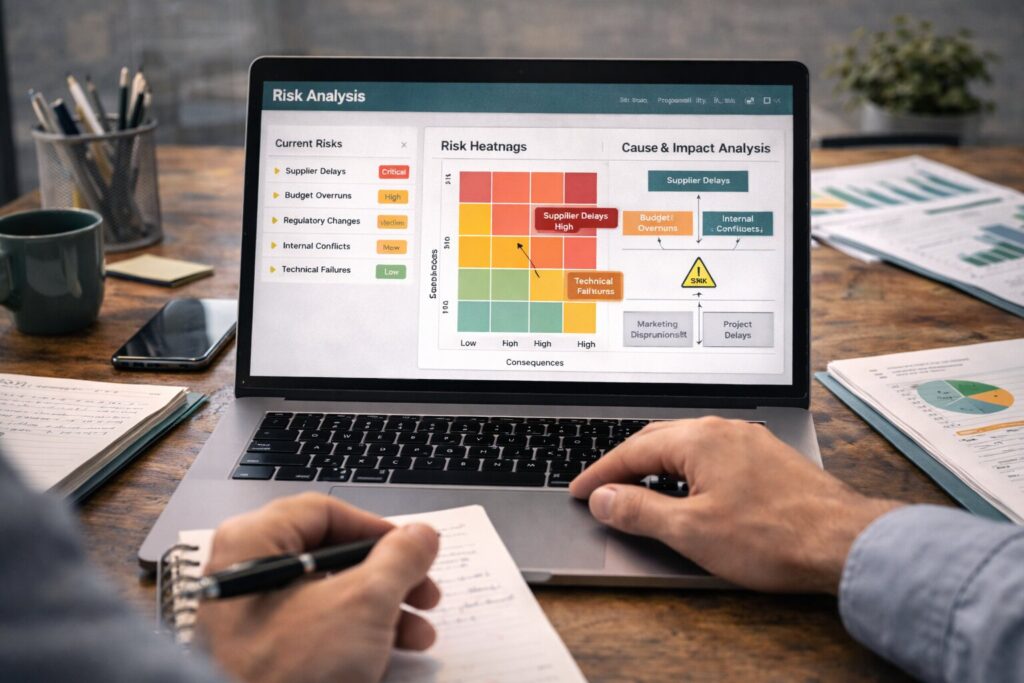
Visual risk matrices and heat maps enable rapid identification of high-priority exposures. Leadership can then allocate resources accordingly.
Strategic resource allocation strengthens resilience. Instead of reacting to the loudest concerns, organizations focus on exposures with the greatest potential impact.
Operational integration across departments
Risk management often spans multiple departments, including finance, IT, operations, and compliance. Risk analysis software facilitates cross-functional collaboration.
Shared dashboards create transparency. Department leaders can view overlapping exposures and coordinate mitigation efforts.
For example, cybersecurity risks may intersect with operational continuity and reputational considerations. Integrated platforms ensure alignment across functions.
Regulatory compliance and audit readiness
Regulatory environments increasingly require structured risk documentation. Risk analysis software simplifies compliance by maintaining auditable records.
Automated reporting reduces administrative burden during audits. Historical tracking provides evidence of mitigation efforts and decision rationale.
Proactive compliance management reduces legal exposure and strengthens credibility with regulators and stakeholders.
Also interesting



Implementing risk analysis software effectively
Successful implementation benefits from a phased approach:
First, define clear objectives. Identify which risk categories require immediate attention and which metrics matter most.
Second, select software aligned with organizational scale and industry requirements. Avoid overcomplicating the system with unnecessary features.
Third, establish governance structures and assign risk ownership. Clarity prevents ambiguity.
Fourth, conduct training sessions to standardize scoring and reporting practices.
Fifth, embed review cycles into executive rhythms to ensure continuous visibility.
This structured roadmap enhances adoption and impact.
Common pitfalls in adoption
Several pitfalls undermine the effectiveness of risk analysis software. One is treating it as a compliance exercise rather than a strategic tool.
Another is failing to update risk registers regularly. Static systems quickly become irrelevant.
Overcomplication also reduces usability. Excessive data fields and complex scoring models may discourage participation.
Balancing thoroughness with practicality ensures sustained engagement.
Leveraging analytics for predictive insight
Advanced platforms increasingly incorporate predictive analytics. By analyzing historical patterns and external data feeds, systems can forecast emerging risks.
Predictive capability supports early intervention. For instance, analyzing supplier performance trends may highlight potential disruptions before they escalate.
However, predictive models should be interpreted cautiously. Human judgment remains essential in validating algorithmic insights.
Aligning risk visibility with strategic planning
Risk analysis software becomes most valuable when integrated with strategic planning. Major investment decisions should reference risk dashboards.
Evaluating risk exposure alongside projected returns enhances decision quality. For example, expansion into a new market should consider geopolitical and regulatory risks documented in the system.
Strategic alignment ensures that risk awareness informs growth rather than constraining it unnecessarily.
Ultimately, risk analysis software provides structure, visibility, and analytical depth in environments characterized by uncertainty. When combined with disciplined governance and continuous review, it transforms risk management from a reactive necessity into a proactive strategic advantage.

Lina Mercer
Lina Mercer is a technology writer and strategic advisor with a passion for helping founders and professionals understand the forces shaping modern growth. She blends experience from the SaaS industry with a strong editorial background, making complex innovations accessible without losing depth. On TheGrowthIndex.com, Lina covers topics such as business intelligence, AI adoption, digital transformation, and the habits that enable sustainable long-term growth.