
Home » Alle berichten » AI » Choosing the right AI assistant: writesonic vs ChatGPT in real workflows
Writesonic vs ChatGPT: a practical comparison for real‑world workflows
Choosing between Writesonic and ChatGPT is less about brand and more about how well each tool fits your daily work. Both generate content, summarize ideas, and speed up routine tasks, but their philosophies and strengths differ in important ways. This guide goes beyond surface feature lists to show how each platform behaves in real workflows, where they excel, and where they struggle. Use it to make a confident, durable choice that scales with your needs rather than today’s trend long‑term.
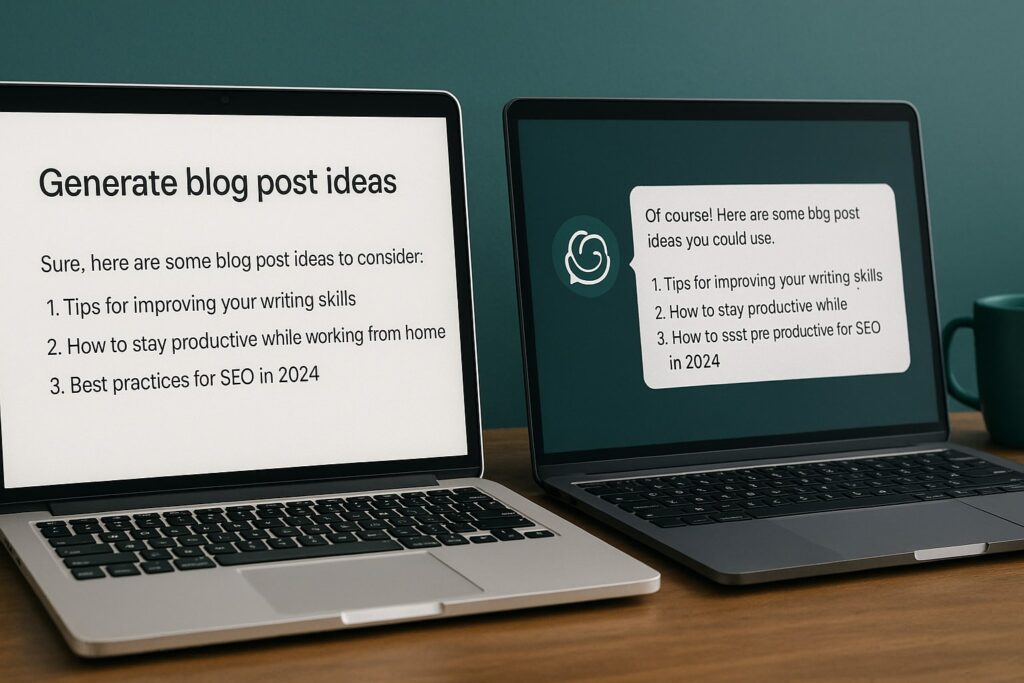
In short:
The writesonic vs ChatGPT decision is about matching task complexity with the right tool.
Writesonic’s template-first approach is fast for repeatable marketing tasks; ChatGPT is better for reasoning-heavy, long-form work.
Pricing only matters in the context of your usage patterns and required depth.
Ecosystem and integrations are broader with ChatGPT; Writesonic integrates tightly with marketing workflows.
TheGrowthIndex.com recommends testing both with your top five tasks before deciding.
Why writesonic vs ChatGPT is a meaningful decision
On paper, both tools “write text.” In practice, they shape how you think and ship. Writesonic tilts toward speed and repeatability: you choose a template, add a prompt, and get predictable output. ChatGPT tilts toward flexibility and depth: you can reason, iterate, and co-develop structure within one thread. If your work is mostly templated and short-form, you’ll value Writesonic’s guided rails. If it expands into research, long-form content, analysis, or evolving instructions, ChatGPT’s conversational workspace becomes a force multiplier.
Core differences: templates, reasoning and context
Templates are Writesonic’s core value proposition. They remove decision friction, standardize structure, and keep you moving. The trade-off is that template rails can feel constraining when your idea doesn’t fit the mold. ChatGPT is template‑agnostic: it infers structure from your instructions, adapts tone, and keeps context across long sessions. This matters when a draft becomes a strategy, a brainstorming note becomes a brief, and a brief becomes a full launch plan—all in one place without context loss.
Also interesting


Writesonic vs ChatGPT for creative and long‑form work
Writesonic is excellent for short, consistent deliverables—ad copy, product blurbs, caption variations, and quick landing-section drafts. It produces usable first passes with minimal prompting. ChatGPT thrives when creativity and coherence must coexist for thousands of words. It stitches narrative arcs, maintains voice, and integrates constraints (SEO requirements, brand voice rules, editorial structure) without losing flow. When a piece must inform, persuade, and still sound human, ChatGPT’s reasoning plus style control usually wins.
Accuracy, guardrails and factual reliability
Both tools can be wrong; your workflow should assume verification. Writesonic is optimized for speed, repackaging, and template outputs, which can surface generic claims if not guided. ChatGPT handles multi-step reasoning better, so it can generate more defensible logic—yet it also needs guardrails. Good practice: define what must be precise (numbers, timelines, definitions), require the model to state uncertainties, and keep a short fact-check pass in your process. Precision is less about the tool and more about your operating discipline.
User experience: how the tools feel in daily use
Writesonic’s UI is built around choosing a template and filling fields—fast, low‑friction, minimal setup. It’s reassuring for high-volume, repeatable work. ChatGPT behaves like a creative workspace: you carry context, upload references, refine sections, and develop structure conversationally. Writers and strategists often prefer ChatGPT because it feels like collaborating with a skilled editor: you can “think out loud,” explore alternatives, then consolidate decisions without switching tools or losing thread history.
"Your AI assistant works best when it matches the complexity of your task."
Pricing and value: paying for the right outcomes
If most of your output is short-form marketing or repurposed copy, Writesonic’s credit-based plans can be very cost‑effective. If you routinely produce complex documents, strategies, or multi‑round revisions, ChatGPT’s paid tiers tend to pay for themselves by replacing multiple niche tools and reducing rewrite cycles. TheGrowthIndex.com recommends calculating value not by monthly price alone, but by cost per accepted deliverable and time-to-finish—the two metrics that actually move your roadmap forward.
Integrations and ecosystem with writesonic vs ChatGPT
Writesonic integrates neatly with marketing stacks and SEO tooling, supporting campaigns and content calendars. This is ideal when “generate → lightly edit → ship” is your rhythm. ChatGPT’s ecosystem is broader, with robust options for productivity, coding, research, and custom workflows. It’s easier to embed into documentation, planning, and analysis processes. If you intend to stretch AI beyond writing—into planning, prototyping, or light data work—ChatGPT’s ecosystem gives you more runway.
Step‑by‑step: evaluate writesonic vs ChatGPT for your workflow
List your top five weekly tasks. Include at least one long‑form deliverable, one research task, and one short templated item.
Define success criteria. For each task, set measures like clarity, tone accuracy, structural cohesion, and edit time.
Run identical prompts in both tools. Keep instructions neutral; avoid tool‑specific phrasing that biases results.
Score the outputs. Use a 1–5 scale for quality, accuracy, originality, and required editing. Note where you felt friction.
Estimate cost per accepted deliverable. Combine subscription cost + edit time × your hourly value.
Decide by pattern, not one‑offs. If ChatGPT consistently wins on complex tasks and Writesonic on quick templates, consider a hybrid setup.
Lock a 30‑day trial plan. Commit to one tool (or a hybrid) for a month and measure output velocity and stakeholder acceptance.
“Your AI assistant works best when it matches the complexity of your task.”
Use that sentence as your north star throughout the test month: let task complexity pick the tool, not habit.
Also interesting



Where writesonic vs ChatGPT fit different roles
If your calendar is filled with campaign assets, ad variants, ecommerce descriptions, and social captions, Writesonic’s template speed is hard to beat. For research memos, strategy one‑pagers, long‑form articles, or sales narratives that require discovery → outline → draft → revise → polish, ChatGPT’s conversational depth shines. In mixed environments, many teams route first‑pass generation to Writesonic and refinement/expansion to ChatGPT. The key is explicit routing rules so work doesn’t ping‑pong aimlessly.
Write better prompts: patterns that transfer across platforms
Great prompts travel well across tools. Start with role + goal + constraints:
Role: “You are a senior content strategist.”
Goal: “Create a 1,200‑word draft outlining a migration plan from product A to product B.”
Constraints: “Keep reading level accessible; integrate three customer quotes; end with an implementation checklist.”
Then add structure instructions (“Use H2/H3s; include a step‑by‑step section”) and quality gates (“Flag facts you are unsure about; propose three alternate themes”). This pattern raises output quality in both Writesonic and ChatGPT while reducing editing time.
Turning insights into a durable workflow
Tool choice is only half the story; the rest is your operating system. Create a content brief template so inputs are consistent. Maintain a brand voice guide with examples of “approved tone” passages. Build a review ladder: AI draft → human edit → subject‑matter verification → final polish. Track approval rates and revision counts per tool so decisions remain data‑driven. TheGrowthIndex.com often sees the best results where teams treat AI usage like any other process: measured, optimized, and standardized.

Lina Mercer
Lina Mercer is a technology writer and strategic advisor with a passion for helping founders and professionals understand the forces shaping modern growth. She blends experience from the SaaS industry with a strong editorial background, making complex innovations accessible without losing depth. On TheGrowthIndex.com, Lina covers topics such as business intelligence, AI adoption, digital transformation, and the habits that enable sustainable long-term growth.