
Home » Alle berichten » Business » Brand vs branding: understanding the difference and why it matters for strategic growth
Brand vs branding: understanding the difference and why it matters for strategic growth
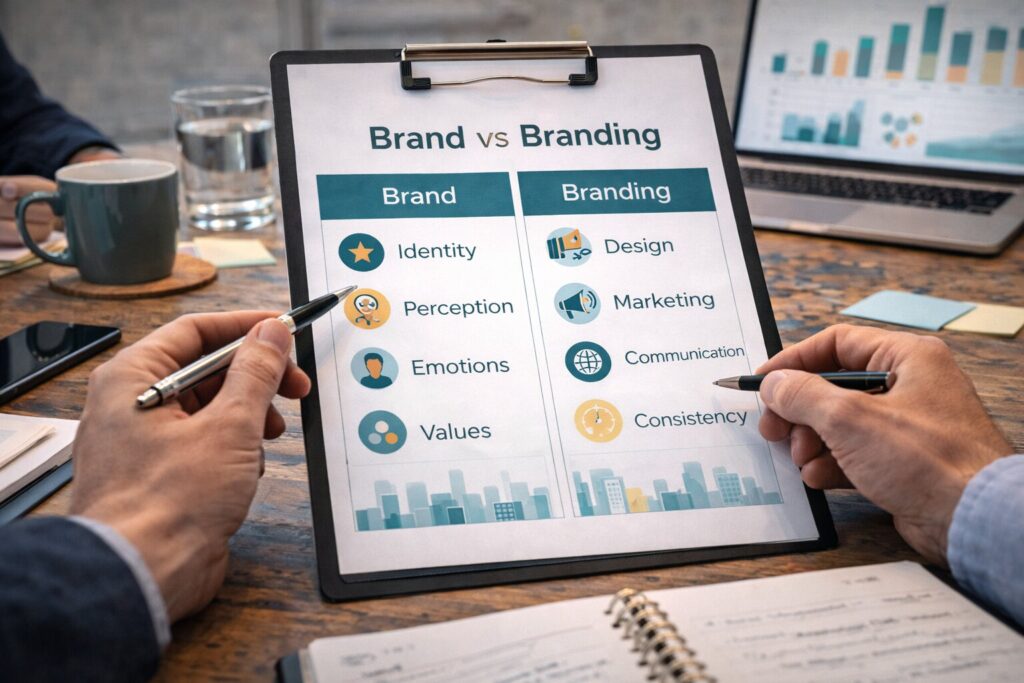
The distinction between brand vs branding is subtle but strategically significant. Many organizations use the terms interchangeably, yet they represent different concepts with distinct implications. A brand is the perception held in the minds of customers, employees, and stakeholders. Branding is the deliberate process of shaping that perception through actions, communication, and experience. Confusing the two leads to superficial marketing efforts rather than sustainable differentiation. Understanding this difference strengthens positioning, credibility, and long-term value creation.
In short:
A brand is perception; branding is the process that shapes it.
Branding includes strategy, communication, and experience design.
Strong brands require internal alignment, not just visual identity.
Measurement and consistency sustain long-term credibility.
Clarity in the brand vs branding distinction improves strategic focus.
Defining brand vs branding clearly
When analyzing brand vs branding, it is helpful to begin with precise definitions. A brand is not a logo, slogan, or color scheme. It is the collective perception formed through repeated interactions.
Branding, by contrast, is the intentional effort to influence and guide that perception. It includes messaging, visual identity, customer experience, tone of voice, and organizational behavior.
In simple terms, a brand is the result; branding is the process.
Why the brand vs branding distinction is strategically important
Misunderstanding brand vs branding often results in short-term cosmetic adjustments. Organizations may redesign visual elements without addressing deeper inconsistencies in customer experience or product quality.
If branding initiatives are disconnected from operational reality, perception will not change meaningfully. Authentic brand strength requires alignment between promise and delivery.
Strategic clarity prevents wasted investment in surface-level changes while underlying behaviors remain unchanged.
Also interesting



Brand as accumulated perception
A brand develops gradually. Each interaction contributes to a cumulative impression.
Customer service interactions, product reliability, leadership communication, and even crisis response shape perception. Branding efforts cannot override repeated negative experiences.
Because perception forms over time, consistency becomes critical. A single strong campaign cannot compensate for inconsistent execution.
Branding as an intentional system
Branding encompasses structured decisions about positioning, messaging, and experience. It defines how the organization wants to be perceived.
This process includes defining target audiences, clarifying value propositions, and designing communication frameworks.
On TheGrowthIndex.com, strategic alignment between declared identity and operational execution is frequently emphasized. Branding must align with strategy to be credible.
Visual identity within the brand vs branding discussion
Visual elements often dominate branding conversations. Logos, typography, and color palettes create recognition.
However, visual identity is only one component of branding. Without clarity in positioning and experience, visual updates have limited impact.
Strong branding integrates visual coherence with strategic messaging and behavioral consistency.
“Focus on aligning what you promise with what you deliver, because branding shapes perception but performance defines the brand.”
Internal alignment and cultural influence
Brand vs branding becomes particularly relevant internally. Employees embody the brand through daily interactions.
If internal culture contradicts external messaging, perception suffers. For example, an organization promoting innovation must demonstrate openness to experimentation.
Internal branding initiatives, such as training and leadership modeling, reinforce consistency between promise and practice.
Measuring brand strength effectively
Brand measurement requires both qualitative and quantitative indicators. Awareness, sentiment, loyalty, and referral rates provide insight.
Financial metrics such as price premium and customer lifetime value reflect economic impact.
Branding efforts should be evaluated based on measurable perception shifts and behavioral outcomes, not solely creative output.
Common misconceptions in the brand vs branding debate
One misconception is that branding ends once visual guidelines are established. In reality, branding is continuous.
Another misunderstanding involves assuming that brand perception can be controlled fully. While branding influences perception, stakeholders ultimately shape the brand through interpretation.
Recognizing this dynamic encourages humility and responsiveness.
Also interesting



Aligning operations with branding strategy
Operational decisions reinforce or undermine branding. Service policies, pricing structures, and communication tone must align with declared identity.
For example, a brand positioning centered on transparency should avoid opaque pricing models.
Cross-functional coordination ensures that branding is reflected in customer experience at every touchpoint.
Brand evolution and long-term sustainability
Brands must evolve carefully. Market conditions, technology, and customer expectations change.
Branding adjustments should reflect strategic shifts without abandoning core identity. Abrupt repositioning without foundation risks confusion.
Structured reviews of positioning and perception maintain relevance while preserving continuity.
Practical framework for strengthening branding efforts
A disciplined approach enhances clarity:
First, articulate the desired perception explicitly.
Second, audit current customer and employee perceptions.
Third, identify gaps between aspiration and reality.
Fourth, align operational practices with intended positioning.
Fifth, communicate consistently across channels.
This process bridges the gap between brand and branding effectively.
The economic impact of brand clarity
Clear distinction between brand vs branding influences financial performance. Strong brands command loyalty, reduce price sensitivity, and attract high-quality talent.
Branding investments yield return when aligned with long-term strategy and operational excellence.
Perception built on consistent experience generates durable competitive advantage.
Ultimately, understanding brand vs branding clarifies where to focus effort. The brand represents accumulated trust and recognition. Branding represents the disciplined work required to earn and maintain that trust.
Organizations that treat branding as a strategic system rather than a design project build stronger, more resilient identities over time.

Lina Mercer
Lina Mercer is a technology writer and strategic advisor with a passion for helping founders and professionals understand the forces shaping modern growth. She blends experience from the SaaS industry with a strong editorial background, making complex innovations accessible without losing depth. On TheGrowthIndex.com, Lina covers topics such as business intelligence, AI adoption, digital transformation, and the habits that enable sustainable long-term growth.