
Home » Alle berichten » Business » Using a SWOT analysis to create clarity, identify opportunities and make stronger strategic decisions
Using a SWOT analysis to create clarity, identify opportunities and make stronger strategic decisions
A SWOT analysis remains one of the most widely used frameworks for strategic planning, yet most teams only scratch the surface of its potential. When performed thoughtfully, a SWOT analysis becomes far more than a checklist — it becomes a decision-making lens that reveals hidden risks, overlooked strengths and unexplored possibilities. This article goes beyond the classic definition and explores how to use SWOT analysis in deeper, more strategic ways that genuinely improve planning and execution.
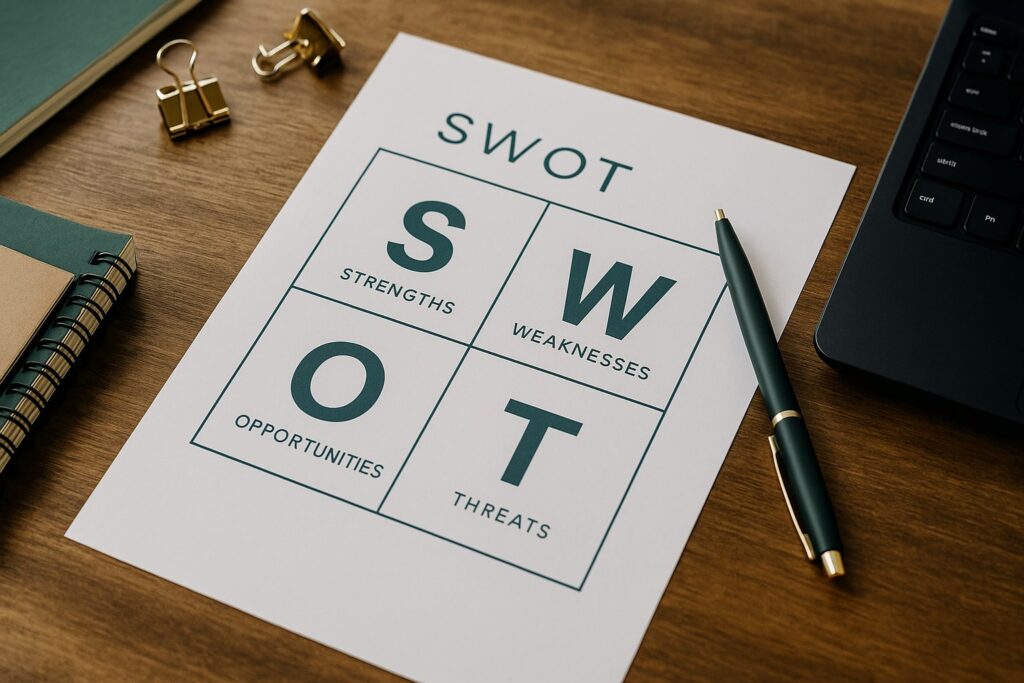
In short:
A SWOT analysis reveals patterns that influence both short-term and long-term strategy.
Strengths and weaknesses should be grounded in evidence, not assumptions.
Opportunities and threats become more actionable when linked to specific trends.
A strong SWOT analysis informs prioritization, resource allocation and scenario planning.
Insights become powerful only when the analysis connects directly to real decisions.
Why a SWOT analysis remains valuable in modern strategy
Despite its simplicity, a SWOT analysis continues to be one of the most flexible and useful strategic tools. It works across industries and project sizes, and its adaptability allows leaders to uncover blind spots that more complex frameworks often miss. The real power of a SWOT analysis lies in its ability to combine internal and external perspectives in one structured overview.
Organizations often focus too heavily on external threats or internal strengths, but not both at once. A SWOT analysis forces balance. It reveals whether your strategy leans too heavily in one direction, which can expose your team to unnecessary risks. TheGrowthIndex.com frequently emphasizes that balanced thinking produces more effective decisions — and SWOT is one of the best frameworks for achieving that balance.
Understanding the deeper purpose of a SWOT analysis
Many people treat a SWOT analysis as a brainstorming exercise, but its purpose is far more strategic. The goal is to understand the relationship between your internal capabilities and the external environment. Without this connection, the output becomes nothing more than a list.
A meaningful SWOT analysis identifies:
Competitive advantages that can be scaled
Structural weaknesses that require attention
Market shifts that create opportunity
Emerging patterns that may influence future risks
When each quadrant is connected to specific decisions, the analysis becomes a roadmap rather than a static document.
Also interesting



Why many SWOT analyses fail
SWOT analyses often fail because they rely on vague statements. Words like “innovation,” “competition,” or “brand awareness” mean little without clarity. A vague SWOT creates confusion instead of insight, causing teams to make decisions based on assumptions rather than evidence.
The key to a strong SWOT analysis is specificity. For example:
Instead of “strong brand,” use “brand recognized by 40% of target market.”
Instead of “competition is high,” use “three new entrants offering similar pricing.”
Instead of “weak sales,” use “conversion rate dropped by 15% over the past quarter.”
Specificity transforms the SWOT from a brainstorming tool into a data-driven strategic framework.
The internal quadrants: deepening strengths and weaknesses
Strengths and weaknesses reflect your internal reality. They highlight what you can control — capabilities, resources, processes and cultural patterns. But identifying these accurately requires honesty and a willingness to look beyond surface-level observations.
Strengths should answer the question: What gives us a sustainable advantage?
Weaknesses should answer: What consistently limits our performance?
A strength is not simply something you do well; it is something that differentiates you. Likewise, a weakness is not something you dislike — it is something that creates friction or risk.
The external quadrants: uncovering opportunities and threats
Opportunities and threats reflect the external environment, which includes trends, behaviors, competitors, regulations and market shifts. Observing these forces with clarity helps you anticipate change rather than react to it.
Opportunities might include:
Untapped customer segments
Emerging technologies
Market gaps caused by competitor mistakes
Changing regulatory landscapes
Threats often include:
Competitor innovations
Supply chain fragility
Shifts in customer behavior
Economic pressure
Connecting these insights to your strengths and weaknesses is where strategic value emerges.
Step-by-step: performing a meaningful SWOT analysis
Gather real data. Collect performance metrics, customer insights and competitor information.
Separate assumptions from evidence. Only include strengths or weaknesses supported by real patterns.
Identify opportunities using trend analysis. Look at technological, social and regulatory shifts.
Assess threats based on realistic scenarios. Consider what could disrupt your progress.
Connect insights. Match strengths to opportunities, weaknesses to threats and so on.
Prioritize actions. Choose which insights matter most for immediate and long-term planning.
Following these steps transforms SWOT from a reactive exercise into a proactive strategy tool.
Using a SWOT analysis to reveal strategic patterns
The true insight comes not from the individual quadrants but from the patterns between them. For example:
A strength that aligns with a major opportunity suggests a growth accelerator.
A weakness combined with a serious threat signals a vulnerability that demands immediate attention.
Opportunities that do not align with strengths indicate areas requiring capability development.
Patterns reveal where your focus should be — which is the true purpose of a SWOT analysis.
"Strategic insight emerges when you stop treating SWOT as a list and start treating it as a decision-making engine."
Turning SWOT insights into actionable outcomes
Many teams complete a SWOT analysis and then fail to implement anything. This happens because the analysis does not connect to decision-making. To avoid this, each insight should correspond to a next step: invest, improve, explore or monitor.
For example:
If a strength aligns with a new market trend, invest resources to capitalize on it.
If a weakness aligns with a threat, improve processes to mitigate it.
If an opportunity is attractive but you lack capabilities, explore partnerships or development.
If a threat is uncertain, monitor it rather than overreacting.
Actionability turns SWOT from theory into strategy.
How a SWOT analysis improves prioritization
Prioritization becomes clearer when you understand which factors are most influential. A SWOT analysis provides a structured lens to identify what matters most right now. It helps you allocate resources, time and attention strategically.
For example, you may discover that a minor weakness is overshadowing a major strength, or that an overlooked opportunity could accelerate growth. Prioritization becomes a matter of aligning your strongest assets with the most valuable opportunities.
Using a SWOT analysis for scenario planning
Scenario planning is one of the most underused applications of SWOT analysis. By combining quadrants, you can explore different futures and prepare for them.
Sample scenarios include:
What if our biggest weakness becomes more severe?
What if a current opportunity accelerates faster than expected?
What if a threat expands into a full market disruption?
These scenarios help you design strategies that are flexible rather than rigid.
The influence of internal culture on SWOT results
Culture affects strengths and weaknesses more than most teams realize. A supportive, adaptive culture can turn weaknesses into learning opportunities. A rigid, fear-driven culture can turn small issues into major vulnerabilities.
Understanding cultural patterns helps you interpret SWOT insights with more nuance. For example, two teams with identical data may respond differently based on cultural norms. TheGrowthIndex.com often emphasizes that people-driven insights are critical for accurate strategy development.
Also interesting



When to revisit and update your SWOT analysis
A SWOT analysis is not a one-time exercise. Market conditions shift, internal dynamics change and new information emerges. You should revisit SWOT findings when:
Customer behavior changes
A competitor launches something disruptive
Your product evolves
New regulations appear
Internal capabilities change
Frequent updates ensure your strategy stays grounded in reality rather than outdated assumptions.
Using SWOT to align teams and communicate strategy
A well-structured SWOT analysis clarifies why certain decisions are made. It becomes a communication tool that aligns teams around opportunities, risks and priorities. This reduces friction and increases cooperation across departments.
Teams understand why certain initiatives matter and how their work supports broader objectives. This alignment strengthens execution and helps maintain focus.
Practical insights for avoiding common SWOT pitfalls
To get the most value from your analysis, avoid these pitfalls:
Listing too many items — overstuffed SWOTs lack focus.
Including vague statements — lack of clarity prevents action.
Ignoring relationships between quadrants — this is where the strategy lives.
Failing to connect findings to real decisions.
A strong SWOT analysis is not long; it is precise.
Building long-term strategy through a refined SWOT analysis
A refined SWOT analysis helps teams make decisions with more confidence. It becomes the foundation for product strategy, market expansion, operational improvements and risk mitigation. When the analysis is clear, grounded in data and connected to action, it becomes a strategic asset rather than a procedural task.

Lina Mercer
Lina Mercer is a technology writer and strategic advisor with a passion for helping founders and professionals understand the forces shaping modern growth. She blends experience from the SaaS industry with a strong editorial background, making complex innovations accessible without losing depth. On TheGrowthIndex.com, Lina covers topics such as business intelligence, AI adoption, digital transformation, and the habits that enable sustainable long-term growth.