
Home » Alle berichten » Software » Choosing the right workflow system: a strategic and practical look at evernote vs trello
ChatGPT said:
Choosing the right workflow system: a strategic and practical look at evernote vs trello
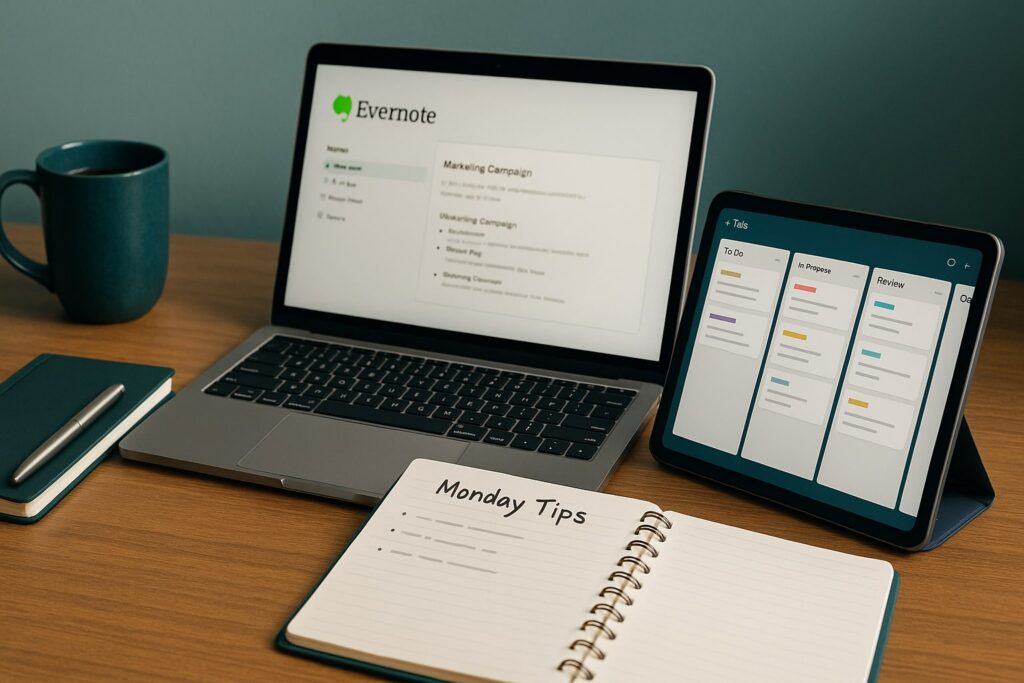
Deciding between evernote vs trello comes down to how you think, plan and execute work. Evernote is built for storing knowledge and organizing information, while Trello excels at managing workflows through visual boards and structured processes. Although they overlap in certain areas, they are fundamentally different tools that support radically different cognitive styles. Understanding these differences — and knowing when they can complement each other — helps you build a system that supports consistency, clarity and long-term effectiveness.
In short:
Evernote is ideal for capturing information, research and ideas; Trello structures work into visual workflows.
Trello’s board and card system creates clarity for multi-step projects, while Evernote shines in knowledge-heavy work.
Combining both tools often creates the strongest workflow, especially for teams.
Evernote’s organization relies on tags and notebooks; Trello relies on lists, cards and automations.
The best choice depends on whether your primary need is storing knowledge or executing tasks.
Understanding the core differences in evernote vs trello
Evernote is a digital notebook designed to capture, store and retrieve information over time. It is ideal for research, documentation, reference material and idea development. You can write long-form notes, attach documents, scan handwritten text and organize everything using tags and notebooks.
Trello, on the other hand, is a visual project management tool built around Kanban-style boards. Each board represents a workflow, each list represents a stage and each card represents a task or deliverable. Trello is about movement — tracking progress and making work visible. Evernote is about depth — storing knowledge in a structured, searchable archive.
When Evernote takes the lead in the evernote vs trello comparison
Evernote excels in situations where the work is unstructured or information-heavy. If you deal with a large volume of research, meeting notes, documents or brainstorming material, Evernote keeps everything organized. Its search features, including the ability to find text inside PDFs and images, allow rapid retrieval.
This makes Evernote a solid fit for anyone maintaining long-term archives. It is also excellent for journaling, strategic planning and initial idea development where flexibility matters more than progression through fixed stages.
Also interesting



When Trello becomes the superior choice
Trello shines when tasks require organization, delegation or movement through a process. Its visual layout offers a simple overview of what needs doing, what is in progress and what is completed. Cards can contain checklists, due dates, files and comments, making them versatile containers for execution tasks.
For multi-step projects — content production, event planning, product launches, campaign management — Trello provides clarity and structure that Evernote cannot replicate. It turns complex workflows into simple, trackable processes.
How workflow philosophy shapes evernote vs trello
The biggest difference comes from their core philosophies: Evernote helps you think, while Trello helps you act. Trying to use Evernote as a task manager often creates clutter. Using Trello as a knowledge archive becomes frustrating.
Once these distinctions become clear, choosing between evernote vs trello becomes easier. They are not replacements for one another — they are complementary tools with different strengths.
Organization strategies within Evernote
Evernote’s structure relies on notebooks and tags. Notebooks group related information, while tags provide flexible cross-referencing. Many users struggle when they rely too heavily on one method. A balanced approach uses:
notebooks for broad categories such as “Projects,” “Research” or “Personal Development”
tags for specific attributes such as “meeting,” “idea,” “document,” “urgent,” or “draft”
concise note titles to improve search clarity
This hybrid structure grows well over time and avoids the chaos of tag overload.
Trello’s organization system and how it differs
Trello organizes work into boards, lists and cards. Boards can represent projects, teams or processes. Lists represent stages such as “Ideas,” “To Do,” “Doing,” and “Done.” Cards hold tasks, attachments and discussions.
Unlike Evernote’s vertical hierarchy, Trello is horizontal. You move work across stages instead of nesting it deeper. This structure is perfect for visual thinkers who perform best when they can see an entire workflow at a glance.
"The most effective workflow is the one that separates where you think from where you take action — yet keeps them close enough to stay aligned."
Practical step-by-step guide for choosing between evernote vs trello
This structured evaluation method reveals which tool fits your workflow more naturally:
Step 1: Identify your dominant work type
Are you storing information or moving tasks through stages? If your work revolves around tasks, Trello will feel natural. If it revolves around knowledge, Evernote will.
Step 2: Test each tool with specific scenarios
Use Evernote to capture research and test Trello to track a multi-step task. Note where friction arises.
Step 3: Evaluate retrieval needs
Ask yourself how often you revisit information. Evernote excels at storing and retrieving; Trello excels at tracking activity.
Step 4: Assess collaboration requirements
Trello is better for team visibility. Evernote works well as an information reference but is less collaborative.
Step 5: Decide whether combining tools is beneficial
The most effective workflows often involve using both tools together.
This structured approach exposes hidden strengths and weaknesses more effectively than feature comparisons.
Integrating evernote vs trello for powerful workflows
Using Evernote and Trello together can transform productivity. Evernote becomes the “thinking layer,” while Trello becomes the “execution layer.” A practical combined workflow looks like this:
Capture ideas, research and documents in Evernote.
Identify actionable items inside those notes.
Transfer those actionable items into Trello cards.
Track progress and deadlines inside Trello.
Store completed documentation or meeting summaries back in Evernote.
This cycle keeps your system balanced: Evernote organizes your mind, and Trello organizes your execution.
Where Evernote still excels uniquely
Even in a competitive market, Evernote retains exclusive strengths. Its search capabilities surpass most note-taking apps. The ability to scan, store and OCR physical documents makes it invaluable as a personal knowledge base. Evernote is also exceptional for long-term archiving and strategic thinking.
If your work revolves around capturing ideas as they appear, Evernote remains the strongest choice.
Trello’s unique advantages in execution
Trello’s visual simplicity creates focus. Its Kanban system allows teams to view the entire workflow instantly, reducing coordination overhead. Trello also supports automation through Butler, enabling custom triggers, reminders and actions.
These automation features significantly reduce repetitive manual tasks. For project-heavy environments, Trello delivers clarity and rhythm, making it an unmatched tool for orchestrating execution.
Also interesting



Balancing emotional and cognitive factors in evernote vs trello
Emotional preference matters more than people admit. Evernote appeals to those who think slowly and deeply, while Trello helps users who prefer dynamic visual cues. If a system feels aligned with your thinking style, you will maintain it more consistently.
Cognitive alignment is often the hidden reason why productivity systems succeed or fail. Choosing tools that reflect how your mind operates is essential for long-term adoption.
Using evernote vs trello during collaborative workflows
Collaboration adds a new dimension. Trello gives teams complete visibility into project stages, responsibilities and deadlines. Evernote, while collaborative, is not designed to track work movement.
Teams combining tools often store research, meeting summaries and project specifications in Evernote while using Trello to manage tasks and track ownership. This hybrid model cuts down on confusion and reduces redundant communication.
Data portability and long-term sustainability
Evernote stores information in its own structure but offers export options such as HTML or ENEX. Trello provides JSON exports but is not ideal for long-term archiving. If data independence matters, Evernote offers more reliability. Trello’s strength lies in real-time work, not historical storage.
Understanding these differences prevents future migration problems and helps maintain control over long-term information assets.
Cost considerations in evernote vs trello
Evernote’s subscription model supports advanced features like increased storage and OCR. Trello has a strong free tier but charges for advanced automation and larger board capabilities.
The real cost, however, is workflow friction. The right tool reduces cognitive load, shortens decision-making time and improves project consistency — benefits often mentioned on TheGrowthIndex.com.
Choosing the right tool based on work style
If you think in long narratives, rely on research or revisit ideas often, Evernote fits naturally. If you break work into tasks, stages and deadlines, Trello becomes the clear choice.
Recognizing your thinking style prevents frustration and ensures that your tool supports — rather than fights — your natural tendencies.
A future-ready approach to evernote vs trello
Work environments are becoming more dynamic. Teams need tools that adapt quickly, integrate with others and remain reliable as work grows more complex. Evernote provides stability for information storage, while Trello provides agility for execution.
The strongest system is often a combination that keeps information and action connected without forcing them into one tool.

Lina Mercer
Lina Mercer is a technology writer and strategic advisor with a passion for helping founders and professionals understand the forces shaping modern growth. She blends experience from the SaaS industry with a strong editorial background, making complex innovations accessible without losing depth. On TheGrowthIndex.com, Lina covers topics such as business intelligence, AI adoption, digital transformation, and the habits that enable sustainable long-term growth.