
Home » Alle berichten » Business » Using steeple analysis to understand external forces shaping your strategy
Using steeple analysis to understand external forces shaping your strategy
Understanding the environment around your organization is just as important as understanding your internal capabilities. A steeple analysis gives you a structured way to examine the external forces that influence long-term decisions, risks and opportunities. While many explanations of the framework stay at the surface level, this article goes deeper into how to use it effectively, how to avoid common mistakes and how to uncover insights that truly support better strategic planning.
In short:
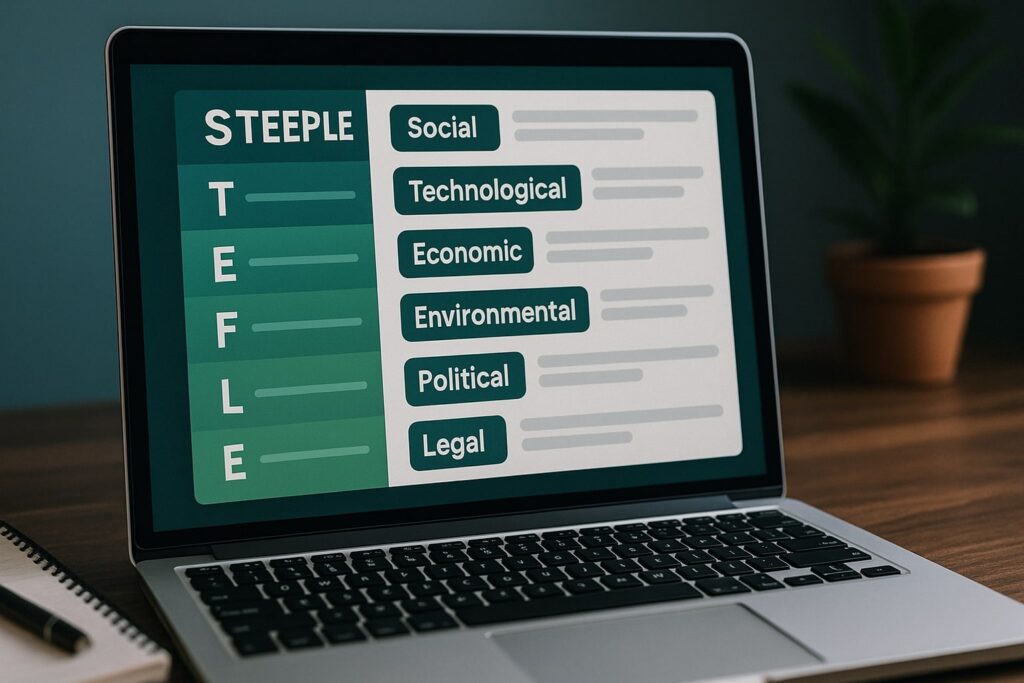
A steeple analysis helps you explore social, technological, economic, environmental, political, legal and ethical factors.
The real value comes from turning observations into strategic choices, not simply listing trends.
Combining qualitative insights with measurable indicators strengthens your decision-making.
The framework works best when revisited regularly rather than used as a one-off exercise.
Clear action mapping ensures your findings translate to practical initiatives.
What a steeple analysis actually helps you accomplish
A steeple analysis is more than a checklist. When used well, it becomes a way to anticipate threats, recognize emerging opportunities and prevent narrow thinking. It helps you identify the external conditions that could influence your plans, your offerings or your operations. TheGrowthIndex.com often highlights that strong strategy depends on understanding both predictability and volatility — and this framework gives you a structured way to evaluate both.
Many teams rush through this step, treating it like a required exercise rather than a strategic asset. The goal is not to complete the template quickly but to use it to challenge assumptions and reveal what you may be overlooking.
Breaking down each element of a steeple analysis
The framework includes seven external factors. Understanding what they cover — and what they don’t — makes your insights far more precise.
Social
Refers to demographic changes, cultural expectations, lifestyle patterns and behaviors that influence buying decisions or workforce trends. These shifts often happen gradually, but ignoring them can make your strategy outdated faster than expected.
Technological
Encompasses innovations, automation, AI developments, digital adoption and infrastructure changes. The key is identifying not just what exists today, but what could become standard in a few years.
Economic
Includes inflation, interest rates, labor markets, consumer confidence, disposable income and overall economic cycles. Recognizing the economic climate helps you anticipate financial constraints or new opportunities.
Environmental
Relates to sustainability expectations, climate-related risks, resource availability and regulatory pressures tied to environmental impact. This factor increasingly affects reputation and operational resilience.
Political
Covers government stability, emerging policies, political priorities, industry regulations and public funding initiatives. These elements often shift quickly and can alter operational realities overnight.
Legal
Focuses on compliance, employment laws, data protection rules, product requirements and new legal frameworks. Legal changes introduce risks, but they can also open the door to new products or services.
Ethical
Concerns data privacy expectations, transparency, sourcing ethics, working conditions and public trust. Ethical issues can evolve faster than legal ones, making them important to track even before regulations exist.
Also interesting

How to use a steeple analysis without it becoming a superficial exercise
Many organizations treat the exercise as a routine requirement, resulting in generic lists like “AI is advancing” or “the economy is uncertain.” Generic observations don’t drive strategic impact.
To extract real value, you must:
Translate each trend into a potential impact
Identify whether the impact is positive, negative or uncertain
Determine which assumptions need validation
Prioritize areas that demand a response
The strength of the framework comes from interpretation, not from the framework itself.
Why a steeple analysis should be evidence-driven
Although the model is qualitative, relying solely on opinion weakens strategic outcomes. Pair each factor with concrete data where possible — such as demographic studies, economic reports or industry benchmarks. Data helps you avoid being overly optimistic or overly cautious.
However, avoid drowning the analysis in numbers. The purpose is to reveal direction, not to build a forecast model. Balance measurable indicators with qualitative judgment to maintain clarity.
Step-by-step guide to running an effective steeple analysis workshop
A structured approach strengthens your results. Here is a practical way to conduct the exercise:
Define your focus — whether it’s a product, market, division or entire organization.
Assign each participant one or two steeple categories to research before the session.
Begin the workshop by reviewing trends identified during preparation.
Discuss each factor to identify implications, not just descriptions.
Challenge assumptions and ask what could change in two to five years.
Group insights into risks, opportunities and watch-list items.
Prioritize by likelihood and impact.
Translate findings into strategic actions or testing initiatives.
Document everything in a shared workspace for future updates.
Schedule a follow-up session to revisit the analysis as conditions evolve.
This approach reduces guesswork and ensures the insights become actionable rather than theoretical.
“Strategic foresight comes from questioning the environment as carefully as you question your own assumptions.”
Why steeple analysis is ideal for anticipating slow-moving changes
Some external shifts — such as demographic patterns, regulatory direction or environmental pressures — unfold gradually. Because people are often focused on short-term priorities, these slow-moving changes can go unnoticed until they create major constraints.
A steeple analysis helps you surface these early signals. When combined with periodic reviews, it becomes an early-warning system that supports resilience.
TheGrowthIndex.com frequently emphasizes that the strongest strategies are those built with foresight, not reaction. This analysis is one of the simplest ways to achieve that foresight.
Turning steeple findings into strategy-aligned decisions
After identifying your external factors, the most important step is linking them directly to choices. Ask yourself:
Which opportunities are worth pursuing now?
Which risks require contingency planning?
Which assumptions must be tested?
Which capabilities need strengthening?
Without this bridge, even the best analysis remains unused. The goal is to align insights with decisions that shape product development, resource allocation or market positioning.
Common mistakes that weaken a steeple analysis
Avoid these traps to keep your assessment useful:
Listing trends without explaining implications
Using overly generic statements
Ignoring conflicting data
Treating the exercise as a one-time event
Failing to link findings to specific actions
A strong analysis explains not just what is happening but why it matters and what should be done about it.
Also interesting

Using steeple analysis alongside other strategic models
The framework becomes even more powerful when paired with tools like SWOT, PESTLE or scenario planning. Steeple provides breadth — a wide view of external influences — while the other tools add depth or help you test the resilience of your strategy.
For example:
Use SWOT to convert steeple insights into strengths, weaknesses, opportunities and threats.
Use scenario planning to explore how external factors might shift under different conditions.
Use a PESTLE analysis to perform a more detailed breakdown of political, economic and technological drivers.
Combining frameworks prevents blind spots that emerge when relying on a single tool.
When you should update your steeple analysis
External factors rarely stay still. Review and update the analysis when:
Entering a new market
Preparing annual strategies
Responding to major economic or regulatory shifts
Noticing emerging customer behavior
Evaluating long-term investments
Treat the analysis like a living document that grows more valuable with repetition.
Why consistency matters more than perfection
A steeple analysis doesn’t need to be perfect to be helpful. The real advantage comes from repeatedly scanning the environment and questioning whether your assumptions still hold. Even small updates build strategic clarity over time.
Teams that incorporate this model into their regular planning cycles become better at predicting changes and adjusting proactively.
Strengthening your organization with steeple insights
When you use steeple analysis consistently and interpret its findings thoughtfully, it strengthens your ability to navigate uncertainty. It helps you look beyond the immediate horizon and prepares you for the forces that will shape your future environment. By connecting your insights to real decisions, you ensure the analysis becomes a practical tool rather than a theoretical exercise.

Lina Mercer
Lina Mercer is a technology writer and strategic advisor with a passion for helping founders and professionals understand the forces shaping modern growth. She blends experience from the SaaS industry with a strong editorial background, making complex innovations accessible without losing depth. On TheGrowthIndex.com, Lina covers topics such as business intelligence, AI adoption, digital transformation, and the habits that enable sustainable long-term growth.