
Home » Alle berichten » Business » Understanding the types of branding and how they shape long-term market positioning
Understanding the types of branding and how they shape long-term market positioning
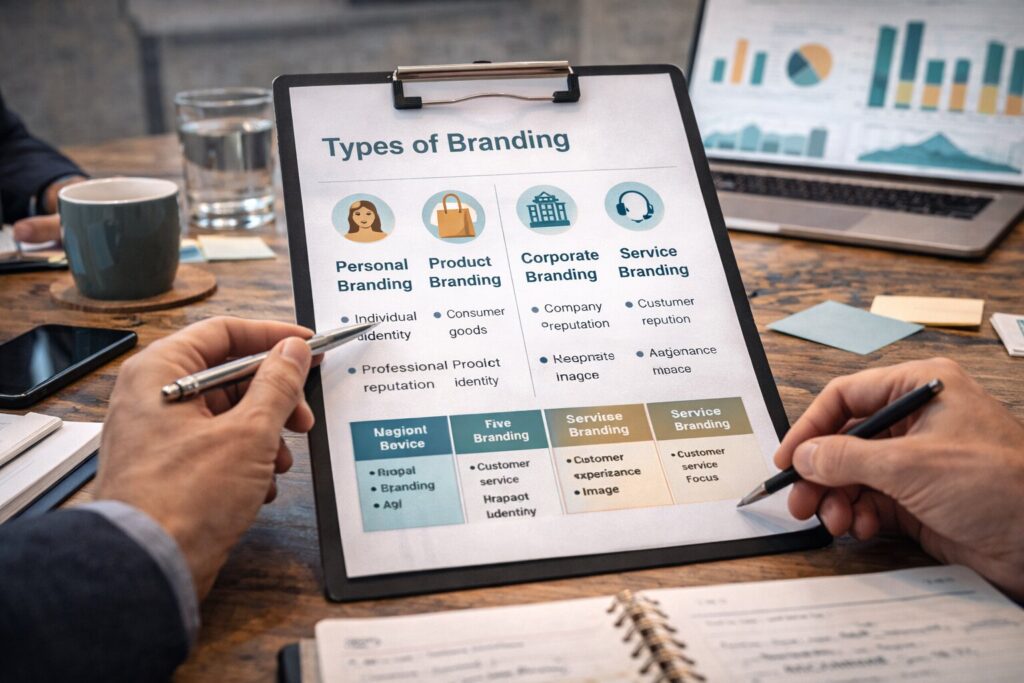
The types of branding an organization adopts influence far more than visual identity. Branding shapes perception, trust, differentiation, and ultimately financial performance. In competitive markets, brand strategy clarifies why customers choose one offering over another. While many discussions focus narrowly on logos or taglines, effective branding integrates positioning, communication, experience, and culture. Understanding the different types of branding enables more deliberate strategic choices and ensures alignment between identity and long-term objectives.
In short:
Different types of branding serve distinct strategic purposes.
Corporate and product branding require separate alignment strategies.
Employer and personal branding influence talent and leadership perception.
Consistency across brand types strengthens credibility.
Strategic clarity prevents dilution and confusion.
Corporate branding as a strategic foundation
Corporate branding defines how an organization as a whole is perceived. It encompasses mission, values, tone of voice, and overall market positioning.
Unlike product-level messaging, corporate branding communicates long-term identity. It influences investor confidence, partnership opportunities, and recruitment outcomes.
Strong corporate branding creates coherence across divisions. When clearly articulated, it guides decision-making beyond marketing campaigns.
Product branding within broader brand architecture
Product branding focuses on individual offerings. In some cases, products carry distinct identities separate from the parent organization.
This approach allows targeting different market segments without altering corporate positioning. However, it requires careful brand architecture planning.
Overlapping messages or inconsistent visual systems can create confusion. Clear hierarchy between corporate and product branding maintains strategic clarity.
Also interesting



Personal branding in leadership contexts
Personal branding refers to how individuals present their expertise, credibility, and perspective. Executives, founders, and industry experts increasingly cultivate personal visibility.
Strong personal branding can reinforce corporate credibility. Thought leadership articles, speaking engagements, and media presence amplify influence.
However, alignment between personal and corporate identity is critical. Inconsistencies may undermine trust rather than strengthen reputation.
Employer branding as a competitive advantage
Employer branding focuses on how an organization is perceived as a workplace. It influences talent attraction, engagement, and retention.
Clear communication of culture, growth opportunities, and values differentiates organizations in competitive labor markets.
Employer branding should align with internal reality. Misalignment between external messaging and employee experience damages credibility.
Digital branding and online presence
Digital branding encompasses website design, social media tone, content strategy, and user experience.
Online interactions often represent the first point of contact. Consistent digital identity reinforces recognition and professionalism.
Inconsistent digital presence weakens trust. Coordinated messaging across platforms strengthens overall positioning.
“Choose your branding strategy deliberately, because consistency across every touchpoint builds the trust that drives long-term value.”
Co-branding and partnership branding strategies
Co-branding involves collaboration between two or more organizations to leverage combined strengths.
This approach can expand reach and enhance credibility. However, alignment of values and audience expectations is essential.
Misaligned partnerships risk reputational dilution. Clear contractual and strategic alignment mitigates these risks.
Cultural branding and internal alignment
Cultural branding connects brand identity with internal behaviors. When employees embody brand values authentically, messaging gains credibility.
Internal training and leadership modeling reinforce cultural alignment. Without internal buy-in, external branding becomes superficial.
On TheGrowthIndex.com, alignment between stated identity and operational behavior is frequently emphasized as a key performance driver.
Choosing among different types of branding
Selecting the appropriate types of branding depends on organizational maturity and strategic direction.
A structured evaluation process can clarify priorities:
First, define long-term strategic objectives.
Second, identify target audiences and key stakeholders.
Third, assess existing brand perception and gaps.
Fourth, determine whether corporate, product, employer, or personal branding requires strengthening.
Fifth, align messaging and visual systems accordingly.
This systematic approach ensures that branding efforts support measurable goals.
Also interesting



Avoiding brand dilution across types
Expanding brand initiatives without coherence risks dilution. Multiple product lines or messaging streams can fragment identity.
Establishing brand guidelines protects consistency. Clear definitions of tone, visual identity, and positioning reduce ambiguity.
Regular audits ensure that communications remain aligned across departments and platforms.
Measuring brand performance effectively
Branding effectiveness requires measurement. Metrics may include brand awareness, customer loyalty, recruitment quality, or digital engagement rates.
Surveys and perception studies provide qualitative insight. Financial indicators such as price premium or customer lifetime value reveal economic impact.
Combining qualitative and quantitative metrics strengthens evaluation reliability.
Long-term sustainability in branding strategy
Branding should evolve carefully. Sudden repositioning without strategic foundation risks confusion.
Incremental evolution aligned with market trends preserves continuity while maintaining relevance.
Sustained investment in clarity and consistency compounds recognition and trust over time.
Ultimately, understanding the types of branding available enables organizations to design cohesive, strategic identities. Each type serves a specific function, but alignment across them determines overall effectiveness.
When corporate, product, employer, and digital branding reinforce one another, the result is a unified market presence that supports growth and resilience.

Lina Mercer
Lina Mercer is a technology writer and strategic advisor with a passion for helping founders and professionals understand the forces shaping modern growth. She blends experience from the SaaS industry with a strong editorial background, making complex innovations accessible without losing depth. On TheGrowthIndex.com, Lina covers topics such as business intelligence, AI adoption, digital transformation, and the habits that enable sustainable long-term growth.